
 Search
Search
[{{{type}}}] {{{reason}}}
{{/data.error.root_cause}}
{{{_source.title}}} {{#_source.showPrice}} {{{_source.displayPrice}}} {{/_source.showPrice}}
{{#_source.showLink}} {{/_source.showLink}} {{#_source.showDate}}{{{_source.displayDate}}}
{{/_source.showDate}}{{{_source.description}}}
{{#_source.additionalInfo}}{{#_source.additionalFields}} {{#title}} {{{label}}}: {{{title}}} {{/title}} {{/_source.additionalFields}}
{{/_source.additionalInfo}}- Details
- Category: Hardware
-
By Jason Gress
- Hits: 957
1MORE Pixie Mini Wireless Microphone M100

1MORE Pixie Mini Wireless Microphone M100
Specifications:
Two Lavalier microphones
Omnidirectional pickup pattern
Connectivity: Dual USB-C Wireless receivers (probably 2.4GHz)
Wireless range from 20 meters to 100 meters depending on obstructions
S/N Ratio: > 70 dB
Reports supporting 24-bit @ 48kHz recording quality
Each microphone is only 6 grams
Charging case with 18 hours of battery life, and 6 hours of recording time for each microphone
Fast charging, with 90 minutes full charge for the microphones and 2 hour full charge time for the case
Mode selection button, with noise canceling, acoustic, reverb, and mute modes
USB-C charging port
Additional magnetic pads and clips included
Wind screens included
Apple Lightning adapter included
USB-C Charging cable included
Hard protective case included for all accessories
One year warranty
MSRP: $89.99
(Amazon Affiliate Link)
Thank you 1MORE for sending us this pair of wireless microphones to review!
We have had the pleasure to review quite a few of 1MORE's headphone lineup, but this is the first microphone from them we've had the pleasure to review. While it's not the first portable lavalier (or lapel) microphone we've reviewed, it's almost certainly the smallest and most portable. While not without flaws, it gets a lot right.
When I received the package, I was concerned at first because a corner was busted in. Thankfully, it was just cosmetic, as there is a fabric-covered hard travel case inside that holds everything in the box, from the microphone to the accessories to the manual - it's all there. Short of an industrial accident, the mic kit and everything important inside is all nearly indestructible, as the case is shockingly strong; I tried sitting on it and it held strong! It's pretty great if you rely on what's inside.
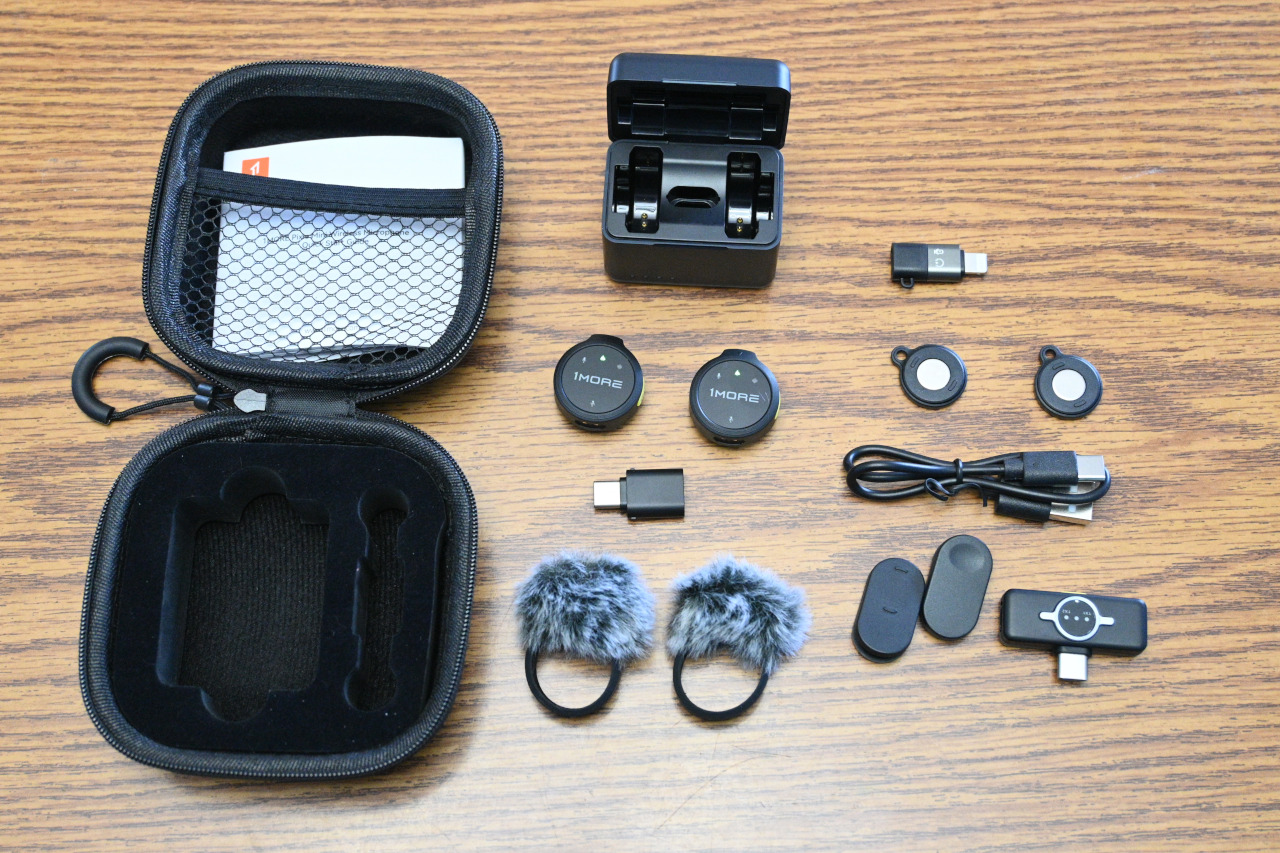
The travel case looks and feels really premium for what it is, and makes a fantastic first impression. It also has a neat-looking zipper pull that's kind of fun to fidget with. Again, that first impression really shines. When you open the case up, you find that inside there are two halves. The top is a mesh pocket, with a box of accessories and the manuals. On the bottom there is a thick foam insert that holds the extra receiver and the main event, the charging case with the microphones and main receiver inside.
If you are really short on space, you only need the small charging case, as it has two microphones, a mini receiver, and magnets to hold the mics in place. The case itself is pretty small, and has a nice rubber bottom with model numbers and other relevant specifications embossed there. The rest is all made of plastic, and it feels like that when you touch it, but it looks nice. The front has four LED lights to denote charge level, and a small indent to make opening the case easy. The top has a stylish 1MORE logo in a reflective style. The rear has the USB-C port used to charge the case, and by extension, what's inside.
When you open the top, you see one microphone and magnetic plate on each side, and the tiny receiver in the middle. It's an extremely efficient use of space. The tiny box is just about two inches long, one and five-eighths inches tall, and one and a quarter inches deep. It's a bit boxy, but still small enough to easily fit in most pockets.
The microphones themselves are also equally tiny; they measure a circle with a one-inch diameter, and are about three-eighths of an inch thick. There is also a magnet attached to the back, which you can use to secure it to your clothes. There are no wires or ports for them, other than the single USB-C port on the charging case.
Outside of the bare minimum as included in that charging case, the larger case has other accessories. The second optional receiver is one; this bigger one has a passthrough USB-C port for charging your phone, which can come in handy for longer recording sessions. It also has a button, but I could not figure out what it was for. Other accessories include a very small USB-C charging cable, two fuzzy wind filters, a lightning adapter, and some additional magnets. Two are circles that I'm not quite sure what they're for, but they seem to maybe have a slightly stronger magnet inside; at the very least they attach to either the microphone or the existing magnetic plates. The final pieces are far more useful: they are magnetic spring-loaded clips that let you clamp onto a shirt rather than just magnetic force. I find the grip to be much more secure when using these.
Strong Points: Crazy light so you won't notice it while wearing; good range; decent sound; dual microphones is very convenient; extremely tiny and portable; second transmitter useful for charging while recording; lots of included accessories; very portable; great battery life
Weak Points: Recording quality could be better, as it's a bit thin and quiet; I wish it included a USB-A to USB-C adapter; on PC it doesn't see 24-bit, but only 16-bit @ 48kHz recording quality
And that better grip is important, because with the default magnets, I've had the microphone fall off a few times. This is doubly annoying when the small inside magnet falls down your shirt, requiring extra wardrobe effort to find and fish out before it gets lost somewhere undesirable. The clips take up more space, so they won't fit in the charging case, but I'm really glad they are included.
These microphones are primarily meant for mobile phone use, but they also work just fine with PCs. I tested it on Windows, Linux, and macOS, and in each case it shows up as a microphone with the name 'USBAudio1.0'. Because it's much easier to test and compare on a PC, I did most of my testing there. I will say that 1MORE advertises a 24-bit @ 48kHz sample rate, but on PC it only seems to support 16-bit @ 48kHz. This is not a huge problem since these microphones aren't really optimized for large dynamic ranges; the bit level means the difference between the quietest and loudest part of what it picks up is limited to the 16-bit limit of 96dB; there is no other difference between 16-bit and 24-bit recordings. 48kHz is otherwise just fine for most use cases.
From a usability standpoint, I really enjoy the 1MORE M100, because there's just something special about just plugging in a mic, clipping it on, and being able to be anywhere within wireless range and just recording. I found that I could walk almost anywhere in my house outside of my garage with my laptop in the kitchen, and recording worked great. Since my kitchen is close to the center of my house, it should work well for most. You could easily record a cooking video without issue, for example. The flexibility of this microphone is just great. The reported battery life of six hours is also fantastic. If you only need one microphone at a time, you could easily swap between the two and keep recording for close to twelve hours, or if you need both, six is still quite a while. Be aware that the audio from both microphones shows up in the same mono audio track; if you were hoping for channel separation, that's not the case here.
When it comes to sound quality, I found a few things to note. For one, they sound the best when held in front of your face, as the mic picks up pretty much every detail. This could be useful in a pinch if you wanted to record a quick song or quick thought, but I wouldn't say it's ideal for longer recordings. I found that if you clip the mic too close to your neck, it might sound a bit worse than clipping it a few inches lower, like say a bit below shoulder length. It seems to be clearer this way, even if it's a bit quieter.
Recording volume is one relative weak point of this microphone. It's certainly usable, but it defaults to fairly high in the recording volume level, so you can't easily raise it much more (it defaults to around 90%). On most other mics I've used, it typically defaults to around 60-70%, which means you have more adjustment range. Given how far your mouth is from the microphone, it makes sense to keep it close to all the way up most of the time with this M100 microphone.
Another weak point with this mic is that the recording quality is decent, but not amazing. For example, I compared this microphone to another lapel mic we reviewed a couple of years ago, the Maono WM620 The 1MORE mic is a lot better in other ways, but the Maono sounds richer and fuller to me. When comparing the two, the 1MORE lacks lower frequencies, and generally sounds a bit thin, while the Maono has a fuller sound. Both sound plenty clear, with voices being very understandable. However, if I was going to use this microphone for a shorter recording, like a game stream, the Maono does sound better, at least to me.
The 1MORE does offer some recording modes. The first and default is noise canceling, which is probably preferred for most use cases. The second mode, acoustic, sounds the best because all processing is disabled, but it's only marginally better than the default. The third mode (you cycle through by pressing the single yellow button on the mic itself) is mute. The fourth is reverb mode, which I recommend against using. It's meant for singing, and in rare cases where you need to sing into this mic in a live music setting, I guess it's better than nothing, but for most I'd disable it. You press it again to go back to the default noise-canceling mode. It's worth noting that 'one-tap mute' and 'one-tap reverb' in the documentation is a bit of a misnomer, since you need to cycle through the four modes to get to them.
The 1MORE Pixie Mini Wireless Microphone M100 is a really great first effort into the wireless microphone market that unfortunately misses the mark. It's a shame that where it matters most, in recorded sound quality, it's merely okay rather than great. As a package, it's better than most, with great battery life, nice accessories, and an amazing storage and travel case. I think 1MORE really nailed that aspect. However, while it certainly sounds decent, I know it could be better. Recordings sounds a bit thin and tinny, whereas some of the competition has a much more broadcast-worthy sound. As much as I was hoping this would be the microphone I could start using for more and more of our content here at Christ Centered Gamer, we're not there quite yet. Hopefully next time!

You May Also Like
Write for us!

Follow Us on X
Watch our next stream!

Allkeys

Save 2% with code CCGR
Follow Us!





-
Verse of the Day - Joshua 1:9
Have not I commanded you? Be strong and courageous. Do not
...
Donate
Please consider supporting our efforts. Since we're a 501 C3 Non-Profit organization, your donations are tax deductible.
Join Our Discord

Who's Online
We have 24595 guests and no members online