
 Search
Search
[{{{type}}}] {{{reason}}}
{{/data.error.root_cause}}
{{{_source.title}}} {{#_source.showPrice}} {{{_source.displayPrice}}} {{/_source.showPrice}}
{{#_source.showLink}} {{/_source.showLink}} {{#_source.showDate}}{{{_source.displayDate}}}
{{/_source.showDate}}{{{_source.description}}}
{{#_source.additionalInfo}}{{#_source.additionalFields}} {{#title}} {{{label}}}: {{{title}}} {{/title}} {{/_source.additionalFields}}
{{/_source.additionalInfo}}House of Leaves
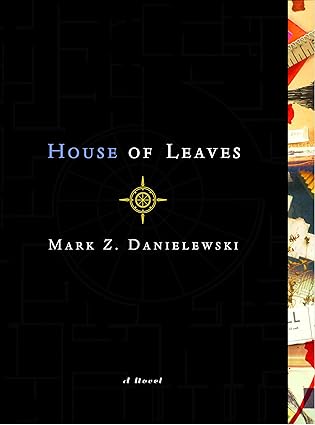
Book Info:
Title: House of Leaves
Author: Mark Z. Danielewski
Publisher: Pantheon, Random House
Publication Date: March 7, 2000
Genre: Horror, metafiction, postmodern, ergodic
MSRP: $29.00
(Amazon Affiliate Link)
House of Leaves is a book so bizarre in its story, themes, telling, and execution that giving it a proper introduction is like trying to introduce the concept of quantum mechanics to an ancient civilization: Where do you even begin? How do you build the scaffolding required to prepare the recipient to understand everything you need to convey? This is partially by design. House of Leaves is considered an exemplary work of "ergodic literature," a classification that essentially means that the book requires the reader to really work to understand the story. I found this article explained the idea well:
Ergodic literature is like a treasure hunt in the world of books, a genre where the reader's journey is as important as the story itself. Coined by Espen J. Aarseth in 1997, the term "ergodic" comes from the Greek words "ergon" (work) and "hodos" (path), emphasizing the effort a reader must invest to traverse these texts. Unlike traditional narratives, ergodic literature demands active participation — flipping pages out of sequence, decoding puzzles, or interacting with the text in unconventional ways.
- Trish G. "Dive into the Madness: Must-Read Ergodic Literature." Bookstr, June 27, 2024, par. 2, https://bookstr.com/article/dive-into-the-madness-must-read-ergodic-literature/, September 15, 2025
So why am I talking about this on a website whose bread and butter is video game reviews? Two reasons:
1. Ever since Dark Souls popularized the idea of storytelling via item descriptions and level design, non-linear storytelling has exploded across video games of all genres. This makes House of Leaves, to borrow the phrase, the Dark Souls of books.
2. House of Leaves was the inspiration for a popular Doom map titled MyHouse.wad, which has since been featured on many popular YouTube channels.
In other words, stories which ask more of the reader than to simply passively soak in the narrative have gained a lot of popularity in recent years, and this book in particular has gained special accolades among gamers. If the concept of being a book that's difficult to understand by its very nature hasn't intrigued you yet, let me give you the pseudo-premise of the book: The narrator, one Johnny Truant, has stumbled across an unpublished manuscript for a book written by a blind man by the name of Zampanò about a nonexistent (even in-universe) documentary film called The Navidson Record filmed by photojournalist Will Navidson as he explores his reality-warping house. Did you catch all that? A blind man. Writing a studied analysis on a movie that he cannot have seen both due to his disability and the lack of the work's actual existence. A film which, according to Zampanò, very much relies on Will's ability to show so much detail with his camera work. Zampanò died before he could publish the work, seemingly haunted and hunted down by some supernatural entity, an entity which is hinted at existing within the mind-bending halls of Navidson's house. When Johnny picks up and begins the work of publishing the manuscript itself, he finds himself plagued by paranoia, sure that he, too, is being stalked by the same entity.
As if describing the layers to House of Leaves wasn't a chore unto itself, Zampanò's book is written as a research document. He provides hundreds of references to scholarly articles, magazine clippings, movies, interviews, and scientific studies throughout the story to back up his points about The Navidson Record. These then get MLA Citation-style footnotes. Hundreds of nonexistent works cited as fact. Further, with Johnny being the final writer in the chain, he interjects with his own thoughts as footnotes in a different font, telling stories that inform the reader about how Johnny's life is degenerating as he is editing the book for release; a portion of the "actual" story will suddenly be interrupted by several pages of Johnny talking about losing his job due to his increasing paranoia, or dive into a very graphic and poetic description of his most recent sexual conquest (which is just as jarring and apropos of nothing when it happens as me mentioning it now). Even the publisher jumps in with a footnote every now and again to clarify when something Johnny interjects makes little sense, as if to assure the reader, "Yeah, we don't know what's going on either." Again, the fictional publisher of the in-universe book which you are physically holding, and not the actual publisher of the actual book which you are physically holding. Does your brain hurt yet? Good, 'cause we aren't done.
To further push the formal research paper style of writing, there multiple appendices in the back of the book containing everything from poetry to pictures of the original documents that Johnny stumbled on in the beginning of the story. The second edition of of the book has a section of note: a series of letters that Johnny had received from his mentally-ill mother. This section, titled E – The Three Attic Whalestoe Institute Letters was published as a separate novella later in the same year that the first edition of House of Leaves was published. The novella, The Whalestoe Letters, has 11 more letters that were not included in House of Leaves (wouldn't want to make this too easy, after all). The letters show the mother's declining mental health, describe accusations the mother has regarding abuse of the institute's staff against the elderly patients there, and serve to better show the relationship Johnny has with the mother he mentions so often throughout his interjections. Given that mental illness is often hereditary, it also further forces the reader to consider the reliability of the story's primary narrator.
As if the very premise of the book and the writing style, with footnote comments everywhere, weren't enough to wade through, the writer plays with word orientation, spacing, and color to affect the mood of the story. In one example, as a character in The Navidson Record is traversing a narrowing corridor, the white space at the edge of each page becomes larger and larger, crowding the text into a smaller and smaller portion of the center of the page, to the point that by the time the character is crawling through a claustrophobia-inducing space, there is barely a tiny box of 3 lines of text on the page for the reader. Sometimes the reader will find themselves having to turn the book sideways or upside down to read it (something I imagine is an absolute spectacle if you happen to be reading this on public transportation).
The thing is, I absolutely love this book. It's suspenseful, it's intriguing, it's chilling, and it leaves you with an emotional gut punch that makes the labyrinthian narrative worth the effort. But as a Christian, there's one glaring problem: Johnny Truant's graphic sex scenes interjected throughout the narrative. I'm sure the author believes these moments serve to show the shallowness of Johnny's human-to-human interactions; give him an excuse to wax poetic about something; or, if we are to question Johnny's truthfulness, to let the reader see where his mind so often lingers. None of that changes the fact that what you're reading is graphic descriptions of sexual acts. I don't know how the author could have kept a similar tone while removing those sections, but I don't know that the story would have lost much by their omission or alteration.
While the sex scenes are the worst offender in House of Leaves, they're not the only problem. Some of the characters in The Navidson Record meet with particularly bloody ends, for starters. Outside of the embedded narrative, Johnny and his friends frequently partake in illicit substances and use very fowl language. Every four-lettered expletive is here, as well as every variant of taking God's name in vain. Again, this is limited almost entirely to Johnny's footnotes, but those show up frequently enough to not be considered "rare". The overall experience is less like a fly in the ointment and more like trying to eat a delicious cake around all the parts that have gone moldy.
House of Leaves is a book I want to recommend so badly...and yet feel entirely convicted about recommending. When it isn't being an X-rated sex- and drug-fueled fever dream, it delivers an unsettling and gripping experience like few other stories can do. If you can somehow avoid those sections of the book, or your conscience is clear regarding books with that type of content, then this book will deliver an unforgettable experience.
When you subscribe to the blog, we will send you an e-mail when there are new updates on the site so you wouldn't miss them.
About the author




Follow Us!





-
Verse of the Day - Joshua 1:9
Have not I commanded you? Be strong and courageous. Do not
...
Donate
Please consider supporting our efforts. Since we're a 501 C3 Non-Profit organization, your donations are tax deductible.
Join Our Discord

Who's Online
We have 24741 guests and no members online
Comments