
 Search
Search
[{{{type}}}] {{{reason}}}
{{/data.error.root_cause}}
{{{_source.title}}} {{#_source.showPrice}} {{{_source.displayPrice}}} {{/_source.showPrice}}
{{#_source.showLink}} {{/_source.showLink}} {{#_source.showDate}}{{{_source.displayDate}}}
{{/_source.showDate}}{{{_source.description}}}
{{#_source.additionalInfo}}{{#_source.additionalFields}} {{#title}} {{{label}}}: {{{title}}} {{/title}} {{/_source.additionalFields}}
{{/_source.additionalInfo}}- Details
- Category: Computer
-
By Dana Schwanke
- Hits: 1848
Vribyss Refuge: Metamorphosis (PC)
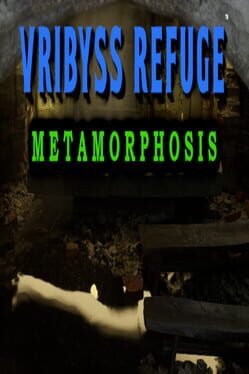
Vribyss Refuge: Metamorphosis
Developed By: Ernesto Aragon
Published By: Vierlyss Entertainment
Release Date: October 28, 2025
Available On: Microsoft Windows
Genre: Action/Adventure, 3D Platformer
ESRB Rating: N/A
Number of Players: Single-player
Price: $1.99
Thank you Ernesto Aragon for sending us a review code!
It's easy to criticize a game when it's the product of a large development studio. When millions of dollars are spent and countless hours from hundreds of people are poured into a product that isn't worth the hard disk space it takes to install, it's an easy target for reviewers to lambast. It's much harder when the game in question is the result of a single person's time and effort.
Ernesto Aragon is the sole developer of Vribyss Refuge: Metamorphosis. He based the stories of the in-game NPCs in part off of the stories of real people in Middle Eastern countries that have been embroiled in war (you can read his comments here). Further, Vierlyss Entertainment is an LLC registered to Ernesto Aragon, meaning he also did the work to publish it on his own. All that is commendable, and I applaud him for the work he did and that he was willing to put his work out there for the world to see and critique.
That said, to say it simply, Vribyss Refuge: Metamorphosis feels more like a college assignment project than a polished end product. The story, gameplay, and environment all feel like they need serious fleshing out.
Let's start with the story. Before starting the game from the main menu for the first time, you have an option to listen to a short introduction to the premise of the game. It's basically a narration of the first paragraph from Ernesto's commentary linked earlier: two oceanographers in the fantasy world known as Vexnion discover a starfish that, when touched, can instantly heal that person of all their ailments. Originally, that was all the audio contained, but it's been updated to further state that the region containing this starfish (later named Vribyss) was colonized by wealthy politicians who bribed and forced their way into power, eventually turning the region into an unlivable, totalitarian hellscape. That in itself is an interesting premise.
Once launching the game proper, however, you are met with a lengthy running dialog between twins Andel (the player character) and Isla about how it's been so long since they've seen each other and how Isla went through some terrible experiences at the hands of the evil Krexxans (the group responsible for taking over the region). The dialog is presented in a window at the bottom of the screen that lacks basic dialog box features like a separate "speaker" box or character portraits. Instead, each line begins with "[Speaker's name] -" before displaying their text. All information in the game is expounded this way, with the entire political dynamic of the area, religious ideas, and backstories of all the characters being presented in unvoiced dialog boxes while both parties perform very minor idle animations for 3-5 minutes. At least in a visual novel, the dialog is displayed with a character portrait to make it immediately clear who is talking and to better portray the speaker's feelings. Contrast that with the opening dialog I mentioned at the top of the paragraph, where we have to infer via the dialog which person is which, and where the player will spend upwards of 5 minutes gazing into the soulless, unblinking eyes of the NPC while she discusses the atrocities she has experienced.
Andel in particular is very worried about "the exploitation of the Vribyss." He says it numerous times in the first region of the game. Not the well-being of the people, but the exploitation of the starfish. I'm sorry, you have chosen one of, like, two creatures on God's green earth without a brain to be concerned for the well-being of. We are talking about a brainless creature whose very touch can miraculously heal any and all people who touch it. That is the type of thing I would absolutely expect people to be clamoring over.
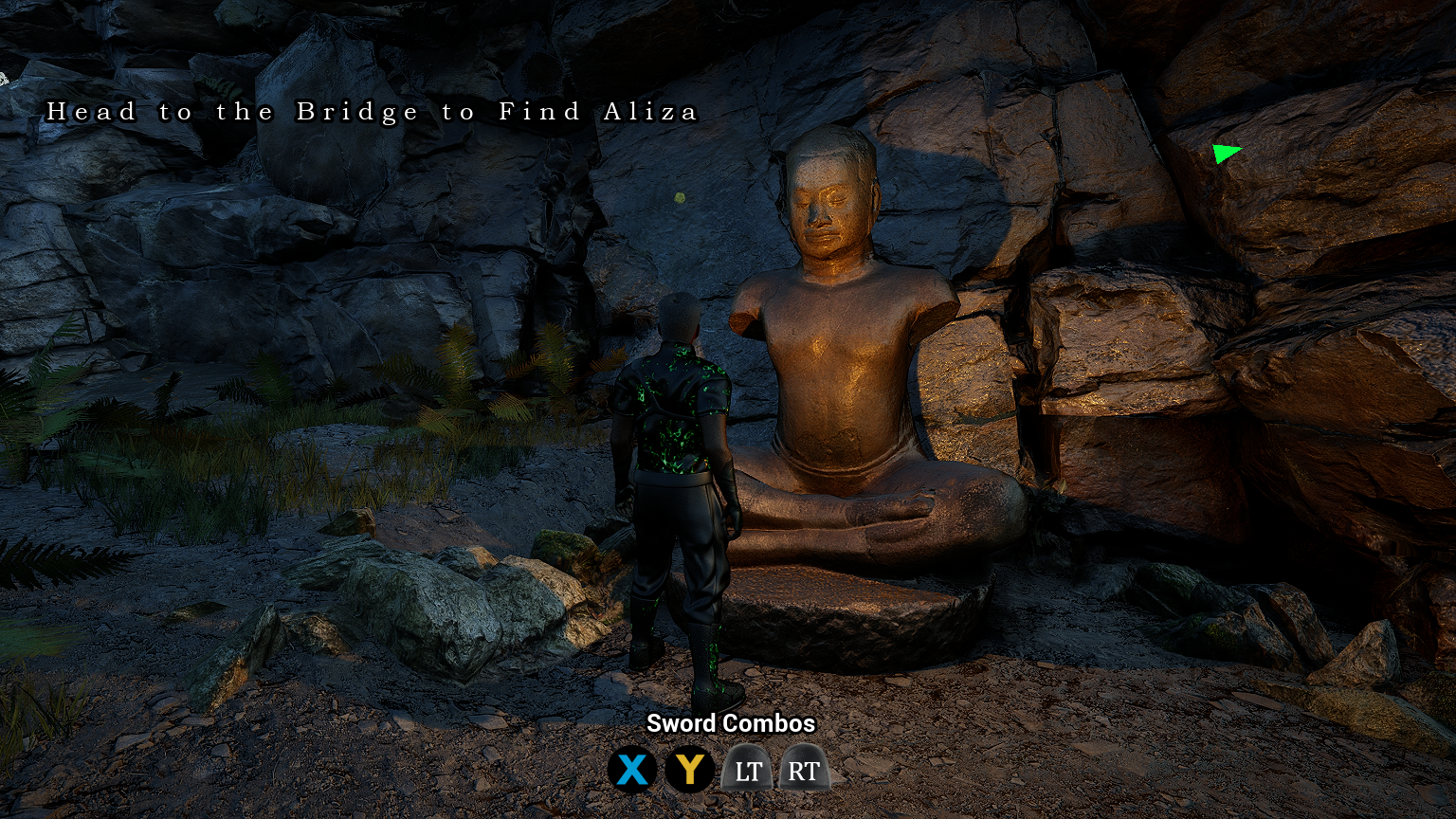
Strong Points: Uses NPCs in the game to tell real-life stories of people in war-torn nations; interesting Middle East-inspired visuals and music
Weak Points: Combat is both lackluster and discouraged; controls are floaty; dialog is underwhelming; the story is exposited through long dialog and often doesn't make sense; environment seems at odds with the story being told
Moral Warnings: Some fantasy violence; descriptions in dialog of rape, murder, suicide, black magic, prophecies, healings, and demonic possessions
It is eventually revealed that the oppression of the people is more over religious matters than physical ones. The story takes a page from "The Lion, The Witch, and the Wardrobe" here: Hadar (God) lives on the exoplanet Shakenah's Domain ("Shekinah" being the word used by real life Christians and Jews to refer to God's physical presence that led the Israelites through their 40 year wanderings and then resided in the temple in Jerusalem), where he cast out Aphass Kexxir (Satan), who now resides on Vexnion (Earth) as the embodiment of evil trying to corrupt people and take more and more power for himself. Kexxir and his Kexxians (demons that can possess the bodies of sinful people after they die) are now using their power in the region to oppress followers of Hadar.
Other than the oddity about exploiting starfish, the story could be interesting, if fleshed out. The problem is everything I just said is infodumped by one or two NPCs in the aforementioned slog that is the dialog system. We don't actually see anything that was mentioned taking place: no telltale signs of war, hunger, or violence in the environment, and no instances of someone dying and suddenly coming back evil. One of the key tenets in making a movie is "Show, don't tell," and that goes double for video games. Why tell the player the story when a video game gives people the opportunity to LIVE the story for themselves?
Then there's the gameplay itself. According to Ernesto, the NPCs are meant to embody some of the real life stories of people he met while abroad in war-torn countries. Vribyss Refuge: Metamorphosis takes place across just a few environments. In each level (with one exception), you progress to the next level by finding and talking to all of the people in the area. The first two levels, in particular, involve you running around a decent-sized map looking for these "refugees" to find and talk to. That's it. That's what moves the game along. And that would be fine, but it sounds like a "walking simulator". However, Vribyss Refuge has a bunch of mechanics that all seem to not quite fit together cohesively.
For starters, there's the swordplay. As you walk around, there are these humanoid, crystalline enemies with swords that appear and will try to attack you. You also have a pair of swords that you can use to attack or block. There is also a "dodge" mechanic that, rather than performing a short hop or roll with invincibility frames to get out of the way, instead transforms Andel into a dash of white light that can be briefly maneuvered before Andel has to stop and collect himself. When you and the enemy are attacking each other, the combat is far from fluid. When you hit the enemy, they flinch, then immediately attack. If the enemy hits you, you flinch. The enemy doesn't do any dodging, countering, or special moves; all enemies are exactly the same. Finally, there is a button combo always displayed at the bottom of the screen. Pressing those buttons in rapid successions will cause Andel to perform a quick series of attacks for massive damage.
Considering the wealth of options for Andel to perform during combat, you would think that combat would be a larger portion of the gameplay loop. To the contrary, Vribyss Refuge actively discourages players from engaging in combat. Whenever an enemy is defeated, they respawn in under 3 seconds. Not only is the respawned enemy even stronger, every single instance of the enemy from then on out is the stronger variant. Beyond that, Andel has no stamina to speak of and can sprint far faster than the enemies can move. There is essentially no reason to ever engage in combat with the exception of one scripted fight near the end of the game (and that fight lasted less than 10 seconds for me).
The combat isn't the only gameplay mechanic that sticks out like a sore thumb. Scattered across the maps are power-ups that permanently raise Andel's health. These power-ups are never explained in-universe and look very out-of-place in the world. Considering the lack of combat previously mentioned, there is very little reason to explore to find these. Not only that, but the game has another oddity: floating starfish. Essentially, little blue Vribyss fly around and show you exactly where to go. The maps are not particularly large or sprawling, and there are invisible walls all over the place to keep you from going out of bounds, so I'm not sure why these little guys were needed. What it ends up feeling like while playing is that the game is actively discouraging you from exploring or taking in the environment. There are also several portions of the game that ask you to "push" boxes out of the way to reveal passages. I say "push" in quotes because Andel doesn't actually have a pushing animation, and it's more like the collision between Andel and the boxes sometimes hopefully makes the boxes move. When boxes are stacked up or in groups, the process is incredibly tedious.

Higher is better
(10/10 is perfect)
Game Score - 50%
Gameplay - 6/20
Graphics - 6/10
Sound - 7/10
Stability - 2/5
Controls - 4/5
Morality Score - 81%
Violence - 6.5/10
Language - 10/10
Sexual Content - 10/10
Occult/Supernatural - 4/10
Cultural/Moral/Ethical - 10/10
The one mechanic that works best is probably the 3D platforming. It's not stellar, and there is a prompt that appears on-screen every single time you approach a ledge that can be climbed, but with the speeds Andel is capable of, running and jumping across gaps to rush towards goals was the part that felt the most fluid. The game also includes these orange spiky balls that teleport you across the map (another thing not explained in any way in-game). Given that Vribyss Refuge: Metamorphosis is a game about finding and helping refugees that are busy trying to hide and escape, I personally feel that a game more about exploring and avoiding detection would better lend itself to the story being told.
Vribyss Refuge is very clearly inspired by Middle Eastern architecture and culture. The entire first map as well as Shakenah's Domain are rife with symbolism that looks like it belongs in an eastern temple. The music is similarly inspired and was very interesting to listen to. Several of the levels felt very much like they had an otherworldly quality to them and were very well put together and fun to see. Some other levels did have some weird graphical bugs, but they were fairly few and far between.
As far as stability is concerned, most of the game played fine, but I experienced one major bug. In the second level, I met the first refugee and then had to exit the game. When I came back, it said I had found 0/3 refugees. I thought that the save point had just been set back further, but when I went exploring, the refugee I had found before was still gone. I then found the second refugee, before again needing to close the game to deal with real life problems. When I came back, the game again said I had found 0/3 refugees, and neither of the first 2 refugees could be found. The third refugee is locked in a cell that can only be opened by talking to both of the first two, and so his cell stayed locked, soft-locking the game and forcing me to start it from the beginning. Luckily, if you're skipping the dialog in the first two levels, the entire game can be completed in under an hour, so getting back to that point in one sitting wasn't difficult. Ernesto has actively been patching the game since it launched, so it's entirely possible it gets fixed in the coming days.
In terms of moral issues, Vribyss Refuge doesn't show a lot to be concerned about, though it does describe a lot of graphic content in text. Combat is bloodless swordplay committed against inhuman monsters that disappear as soon as they die. In text however, the NPCs describe rape, miscarriage, the murder of innocents, black magic, demon possessions, prophecies, healings, and suicide. All NPCs are modestly dressed, and no foul language is used by anyone.
Vribyss Refuge: Metamorphosis has the bones of a good game in it, and it's only $2. The credits conclude with a slideshow of Ernesto in various countries, showing the people who inspired him to create his game. While this isn't a game I can recommend the average person purchase, I do appreciate the time, effort, thought, and feeling that went into making it. I also appreciate that the developer has already put effort into fixing bugs and fleshing out the story just in the days since I started playing it. And if you're someone who wants to support a Christian game dev and someone who wants to tell the stories of real people in a unique way, then consider giving this game a try for yourself.
-maestro_dana

You May Also Like
Write for us!

Follow Us on X
Watch our next stream!

Allkeys

Save 2% with code CCGR
Follow Us!





-
Verse of the Day - Joshua 1:9
Have not I commanded you? Be strong and courageous. Do not
...
Donate
Please consider supporting our efforts. Since we're a 501 C3 Non-Profit organization, your donations are tax deductible.
Join Our Discord

Who's Online
We have 22428 guests and no members online