
 Search
Search
[{{{type}}}] {{{reason}}}
{{/data.error.root_cause}}
{{{_source.title}}} {{#_source.showPrice}} {{{_source.displayPrice}}} {{/_source.showPrice}}
{{#_source.showLink}} {{/_source.showLink}} {{#_source.showDate}}{{{_source.displayDate}}}
{{/_source.showDate}}{{{_source.description}}}
{{#_source.additionalInfo}}{{#_source.additionalFields}} {{#title}} {{{label}}}: {{{title}}} {{/title}} {{/_source.additionalFields}}
{{/_source.additionalInfo}}- Details
- Category: Computer
-
By Daniel Cullen
- Hits: 2179
Fantasy Maiden Wars - DREAM OF THE STRAY DREAMER - (PC)
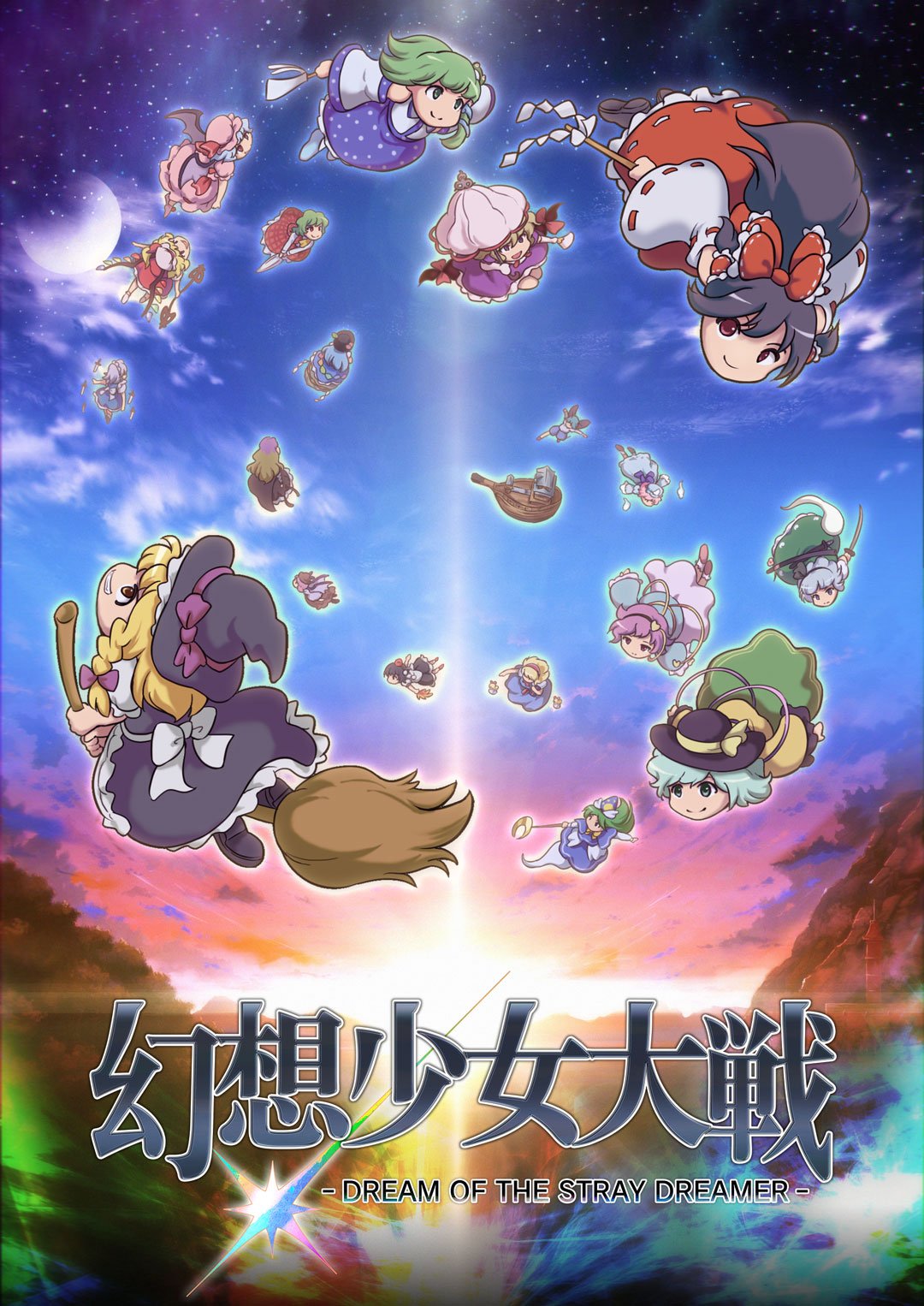
Fantasy Maiden Wars - DREAM OF THE STRAY DREAMER -
Developed By: さんぼん堂
Published By: Phoenixx Inc.
Released: October 20, 2025
Available On: Microsoft Windows, Switch
Genre: Turn-Based Strategy
ESRB Rating: CERO B (ESRB Teen equivalent)
Number of Players: Singleplayer
Price: $34.99
Note: This review concerns the PC Steam release. The Switch version is Japanese only, and the original Complete Box version is not covered, though key differences will be noted.
I'd like to thank Phoenixx Inc. for the review key to this title.
Imitation is the highest form of flattery, though innovation is even more laudable. A work of art that manages to do both is exciting, if you ask me, and Fantasy Maiden Wars - DREAM OF THE STRAY DREAMER - does both very well indeed.
A bit of background first. Fantasy Maiden Wars is an adaptation of the Touhou franchise. Touhou is primarily about a series of Danmaku (literally "bullet barrage", also called "bullet hell" in Western regions) games that involve tense shoot'em up action in top-down stages where tons of enemies are onscreen trying to kill you, and you need to do the same first. Enemies are often spraying the screen with various types of bullets, which tends to make these types of games highly challenging. The world setting is Gensokyo, a mystical realm in which humans and creatures of myth exist side by side.
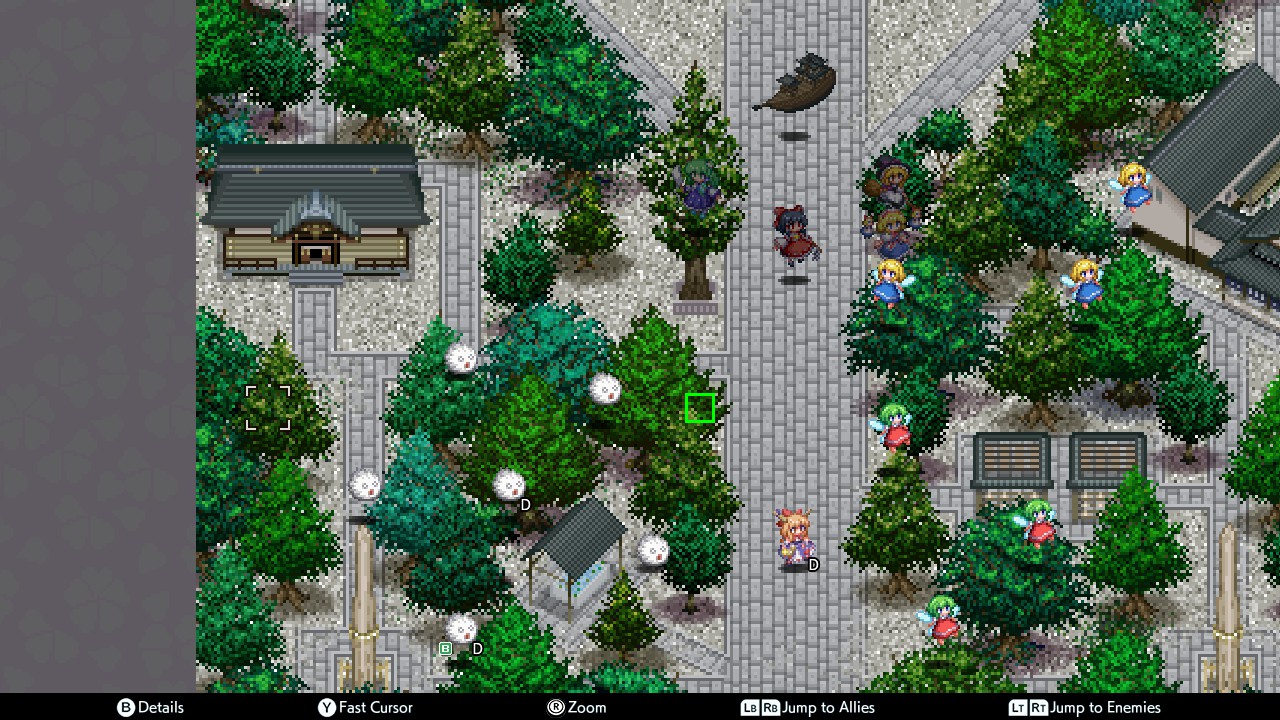
It also bears noting that Fantasy Maiden Wars is a turn-based strategy game adaptation of the Touhou universe, specifically in the style of the Super Robot Wars series. Super Robot Wars gameplay typically involves moving characters like chess pieces across a top-down grid to eliminate enemies and complete stage objectives. In between stages are story scenes told in visual novel style and intermissions where characters can be upgraded for later challenges. Fantasy Maiden Wars reenacts many canon stories from the original Touhou games and related works in this format.
The gameplay largely imitates Super Robot Wars, and it also homages key elements of Touhou. Some enemies generate "danmaku fields", which can induce penalties to player characters caught in them, and danmaku fields can stack. Some boss characters have "spellcards", which are danmaku fields with additional unique penalties, making them quite dangerous. Some enemies can drop Bombs, which are free attacks that players can use to do a flat amount of damage to all enemies in their area of effect and temporarily remove danmaku fields.
Finally, a bit of legal and other clarification. Fantasy Maiden Wars' Steam release is a port of the Japanese-only Switch release. This was derived from the original "Complete Box" fangame release that consisted of four separate fangames into one huge game. The Steam release is basically a bug-fixed version of Complete Box with a full English translation. The original fangames had English translations, but the Steam release takes that a bit further, having received an official commercial release with a revised translation overseen by one of the official translators for the Super Robot Wars games. This did result in some modified text, removing or censoring certain blatant references to other works that could have resulted in legal trouble, but the game is otherwise faithfully translated.
The following games and other media are represented:
Strong Points: Fun Touhou fangame; great music; interesting and in-depth turn-based strategy gameplay
Weak Points: May not be your thing if you are not a fan of Touhou
Moral Warnings: Turn-based RPG style violence; a few instances of harsh language (h*ll, d*mn, s***, a**); profound references to Shinto, Buddhist, and Taoist religions, as well as Western-style fairies and vampires; frequent references and depictions of alcohol
The game proper starts with the player choosing their main protagonist, Reimu or Marisa (both largely cover the same events, but have their own exclusive scenes and certain character-specific secrets). After this, the game begins with what is basically the opening plot of the sixth Touhou game. From there, events snowball, covering events from later Touhou titles, with some original content specific to this game. Without spoilers, your protagonists investigate incidents that are causing problems in Gensokyo, and what starts out simple turns into a major crisis that threatens all of the land. There are four story arcs (Scarlet, Mystic, Eternal, Dream) which correspond to the four separate games that were combined into one for PC/Switch.
A few final notes. Unlike the fangames this is based on, this game has a decent amount of tutorials to get you used to the gameplay. Second, you don't need to know anything about Touhou or Super Robot Wars, but prior knowledge of either will really make understanding the story and gameplay a lot easier. I personally played this as a Super Robot Wars veteran, so the gameplay was simple. I did find myself looking up a lot of Touhou lore to get the context for a lot of things, but the story itself is pretty intelligible even if you don't.
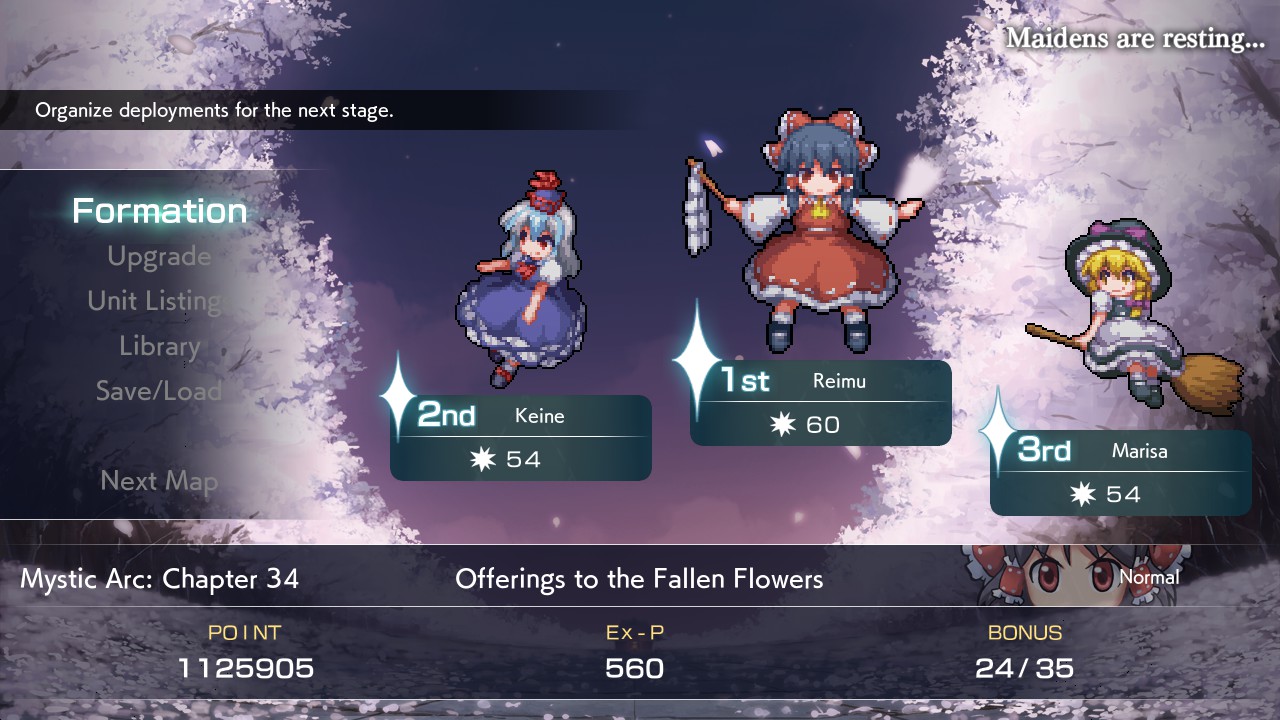
Graphically, this game uses a hand-drawn anime style. Most of the character art is in the style of early PS1 pixel artwork, while some battle animations can feature very smooth modern anime-style artwork. Given that this game was based on a fangame that was later made into an official commercial release, it looks quite good.
The sounds and music are excellent. The music is a mix of Touhou fan remixes and some original music in the same style as the Touhou games. Most of this has a very anime-inspired sound, ranging from cute slice-of-life music, dramatic rock and synth music, and even some chiptune-style music. There is an immense amount of music on hand, which is why the DLC for the music is so pricey (but worth it if you like the game). Unlike the Super Robot Wars games this game is emulating, there are no voiced characters.
This game can be controlled with a keyboard and mouse or any Steam-supported controller. Both styles are fully viable. The game comes with easy-to-understand tutorials. There is no button remapping, but the controls are already very simple as is, and the screen gives clear markings for what buttons do what anyway.
Stability is pretty good. This title runs natively on Microsoft Windows. It will run out of the box on Linux and the Steam Deck via Steam Proton (confirmed Verified for the latter). Requirements are also pretty modest, so even low-end computers should be able to run this fine.
Higher is better
(10/10 is perfect)
Game Score - 88%
Gameplay - 18/20
Graphics - 7/10
Sound - 9/10
Stability - 5/5
Controls - 5/5
Morality Score - 64%
Violence - 6/10
Language - 7/10
Sexual Content - 10/10
Occult/Supernatural - 0/10
Cultural/Moral/Ethical - 9/10
Morally, there is some concerning content.
Violence is presented in "give orders and watch it happen" turn-based RPG style. Given the art style, there are no graphic displays of blood and/or gore. Violence is typically done either in self-defense, by mutual consent (battles are considered a form of sport in some contexts), or to combat mutual threats by all parties concerned.
The language is mildly earthy. While there is not a profuse degree of profanity, there are a few instances of harsh language like d*mn, h*ll, a**, and s***. There is little to no crude humor or sexual commentary. This matches the source canon, which also lacked this.
The art style of the source canon had very little in the way of sexualized depictions, and Fantasy Maiden Wars follows suit. Despite the highly female cast, there is also little in the way of sexual depictions or activity.
The occult and supernatural are in profound display. The main setting draws heavily from Shinto, Buddhist, and Taoist traditions. The swastika (in the original Eastern religious sense) can be seen in a few parts of the gameplay. The world setting also incorporates some Western concepts, such as fairies, vampires, and so on. There is one story arc concerning a character with necromantic abilities, and those with power over the dead and/or undead can join as player characters.
Morally, the player cast generally seeks to resolve incidents that disturb the setting's peace and order. There are lots of discussions of alcohol and the imbibing of alcoholic beverages. The cast, when possible, tries to act with the cooperation of lawful authority (by Touhou standards).
Overall, I found this game to be very fun. Technically, it's pretty solid and runs well on modest hardware. Morally, it has a lot of concerning themes that are generally fit only for teenagers and up. If you love Touhou and/or Super Robot Wars, or just want a fun and challenging turn-based strategy game, then I highly recommend this title.

You May Also Like
Write for us!

Follow Us on X
Watch our next stream!
Allkeys

Save 2% with code CCGR
Follow Us!





-
Verse of the Day - Joshua 1:9
Have not I commanded you? Be strong and courageous. Do not
...
Donate
Please consider supporting our efforts. Since we're a 501 C3 Non-Profit organization, your donations are tax deductible.
Join Our Discord
Who's Online
We have 22514 guests and no members online