
 Search
Search
[{{{type}}}] {{{reason}}}
{{/data.error.root_cause}}
{{{_source.title}}} {{#_source.showPrice}} {{{_source.displayPrice}}} {{/_source.showPrice}}
{{#_source.showLink}} {{/_source.showLink}} {{#_source.showDate}}{{{_source.displayDate}}}
{{/_source.showDate}}{{{_source.description}}}
{{#_source.additionalInfo}}{{#_source.additionalFields}} {{#title}} {{{label}}}: {{{title}}} {{/title}} {{/_source.additionalFields}}
{{/_source.additionalInfo}}Protecting Your Trading Cards Properly
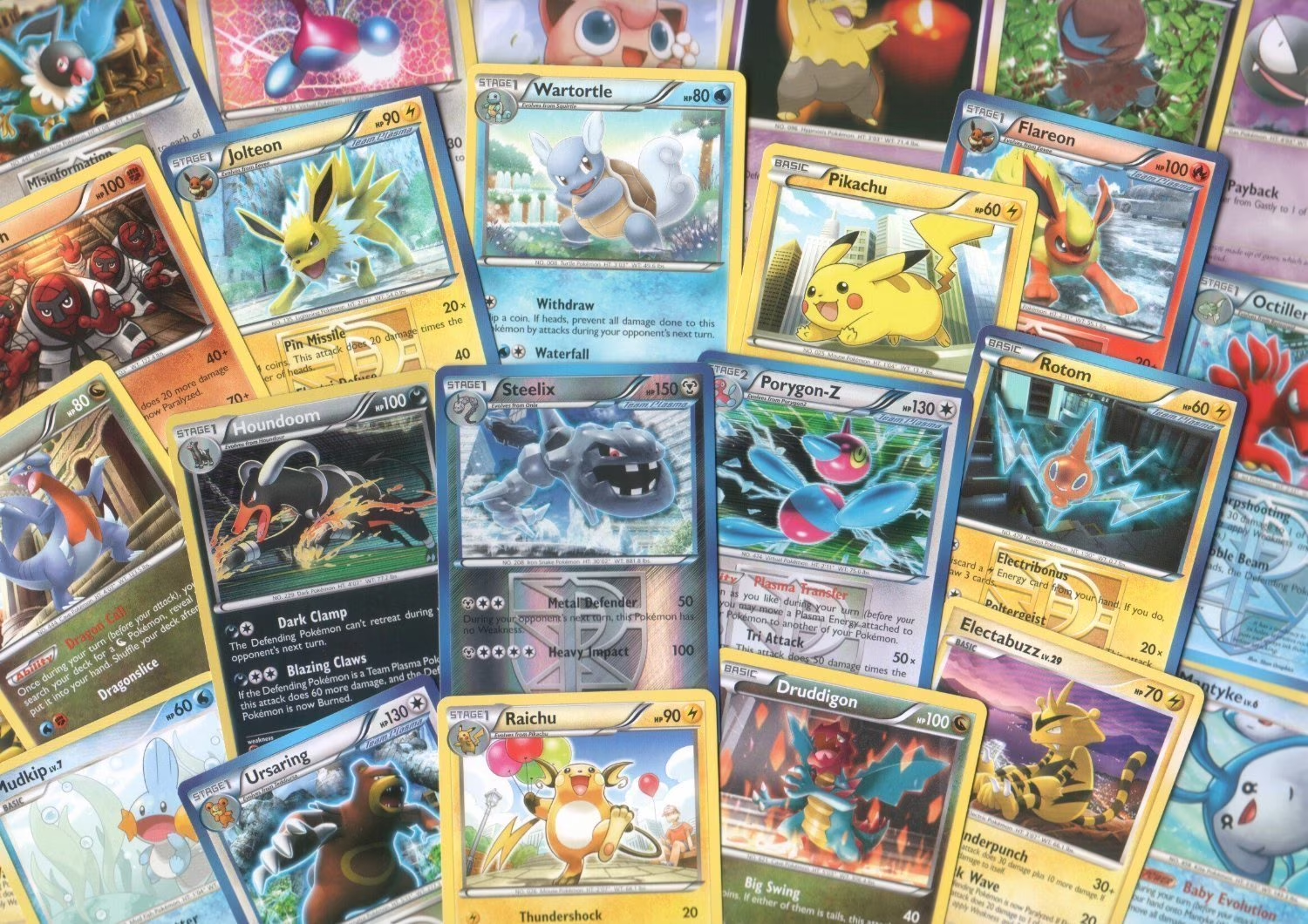
Trading cards are highly sensitive collectibles. Minor physical damage such as surface scratches, edge whitening, or corner dents can dramatically reduce a card's condition and its grading score. For collectors and players alike, proper storage and handling practices are essential for preserving card quality over time. Maintaining card condition requires protective materials, controlled storage environments, and careful handling techniques that prevent both mechanical and environmental damage.
Understanding how trading cards deteriorate allows collectors to implement storage systems that maintain their long-term value.
Use Protective Sleeves ImmediatelyThe most important step in protecting trading cards is placing them in protective sleeves immediately after opening booster packs or receiving them from trades. Direct exposure to air, dust, and skin oils can degrade card surfaces quickly.
A high-quality card sleeve creates a barrier between the card and external contaminants. These sleeves are typically made from acid-free polypropylene, which prevents chemical reactions that could discolor or weaken the card material.
Protective sleeves provide several benefits:
- Prevent surface scratches from friction
- Protect card edges during handling
- Reduce exposure to oils from fingerprints
- Prevent dust and debris from contacting the card surface
When cards remain unsleeved, even brief contact with other cards or rough surfaces can produce micro-abrasions that lower grading potential.
Serious collectors often sleeve cards immediately after they are opened to eliminate unnecessary exposure.
Double Sleeve Valuable CardsFor rare or high-value cards, many collectors use a double-sleeving technique. This method involves placing the card in a tight-fitting inner sleeve and then inserting it into a standard outer sleeve.
The inner sleeve fits closely around the card, preventing movement. The outer sleeve adds an additional layer of protection against dust and moisture.
Double sleeving provides several advantages:
- Reduces card movement inside the sleeve
- Creates an additional moisture barrier
- Prevents contaminants from entering the sleeve opening
This technique is widely used for cards intended for professional grading or long-term storage.
Use Rigid Protection for Structural SafetyWhile sleeves protect card surfaces, they do not prevent bending. Cards can easily warp or crease if they are stored without structural support.
Rigid storage options include:
- Plastic toploaders
- Magnetic card holders
- Graded slab cases
- Semi-rigid card holders used for grading submissions
Toploaders are one of the most common rigid storage options because they allow collectors to slide sleeved cards into hard plastic sleeves that prevent bending.
For extremely valuable cards, magnetic holders provide a tight seal that holds the card securely in place while protecting it from external pressure.
Rigid protection is particularly important when transporting cards to events or storing them in larger collections.
Control Environmental Storage ConditionsEnvironmental factors such as temperature and humidity can cause long-term damage to trading cards. Because most cards are printed on layered paper stock, moisture and heat can warp or weaken the card structure.
Proper storage conditions include:
- Stable temperatures between 65°F and 72°F
- Relative humidity levels between 35% and 50%
- Minimal exposure to sunlight or UV radiation
Sunlight can fade ink pigments and degrade protective coatings on the card surface. Cards should always be stored away from direct light sources.
Many collectors use sealed storage boxes or cabinets to maintain stable environmental conditions.
Organize Cards to Prevent Friction DamageImproper storage arrangements can cause cards to rub against each other, which gradually damages edges and surfaces.
Organized storage systems prevent this type of wear. Common storage solutions include:
- Archival card storage boxes with dividers
- Binders with side-loading card pages
- Plastic storage containers designed for trading cards
Archival materials are recommended because they are acid-free and designed for long-term preservation.
Cards should be stored vertically within storage boxes to prevent uneven pressure that may bend the cards.
Proper organization also allows collectors to access specific cards without repeatedly handling the entire collection.
Handle Cards CarefullyEven when cards are properly stored, handling mistakes can still cause damage. The most common issues include bent corners, fingerprints, and surface scratches.
Collectors should follow several basic handling guidelines:
- Hold cards only by their edges
- Avoid touching the printed surface
- Place cards on clean, soft surfaces when sorting
- Wash hands before handling cards
Handling cards with clean hands prevents oil transfer, which can stain card surfaces over time.
Some collectors use nitrile or cotton gloves when handling extremely valuable cards to eliminate skin contact entirely.
Inspect Storage Materials RegularlyProtective sleeves and storage materials should be inspected periodically. Over time, sleeves can wear out or accumulate dust that may transfer to the card surface.
Signs that sleeves should be replaced include:
- Visible scratches on the sleeve surface
- Cloudy or discolored plastic
- Loose sleeve fit allowing card movement
Replacing worn sleeves ensures that cards remain fully protected.
Routine inspections also allow collectors to detect early signs of environmental damage or storage issues.
Properly protecting trading cards requires a combination of high-quality sleeves, rigid storage solutions, stable environmental conditions, and careful handling practices. By using protective materials and maintaining organized storage systems, collectors can preserve both the physical condition and long-term value of their trading card collections. Consistent protection practices ensure that cards remain in near-mint or mint condition for years to come.
When you subscribe to the blog, we will send you an e-mail when there are new updates on the site so you wouldn't miss them.
About the author




Follow Us!





-
Verse of the Day - 2 Peter 1:4
He has given us his very great and precious promises, so
...
Donate
Please consider supporting our efforts. Since we're a 501 C3 Non-Profit organization, your donations are tax deductible.
Join Our Discord

Who's Online
We have 28600 guests and no members online
Comments