
 Search
Search
[{{{type}}}] {{{reason}}}
{{/data.error.root_cause}}
{{{_source.title}}} {{#_source.showPrice}} {{{_source.displayPrice}}} {{/_source.showPrice}}
{{#_source.showLink}} {{/_source.showLink}} {{#_source.showDate}}{{{_source.displayDate}}}
{{/_source.showDate}}{{{_source.description}}}
{{#_source.additionalInfo}}{{#_source.additionalFields}} {{#title}} {{{label}}}: {{{title}}} {{/title}} {{/_source.additionalFields}}
{{/_source.additionalInfo}}- Details
- Category: Switch 2
-
By Tyler Ferguson
- Hits: 1666
Hyrule Warriors: Age of Imprisonment (Switch 2)
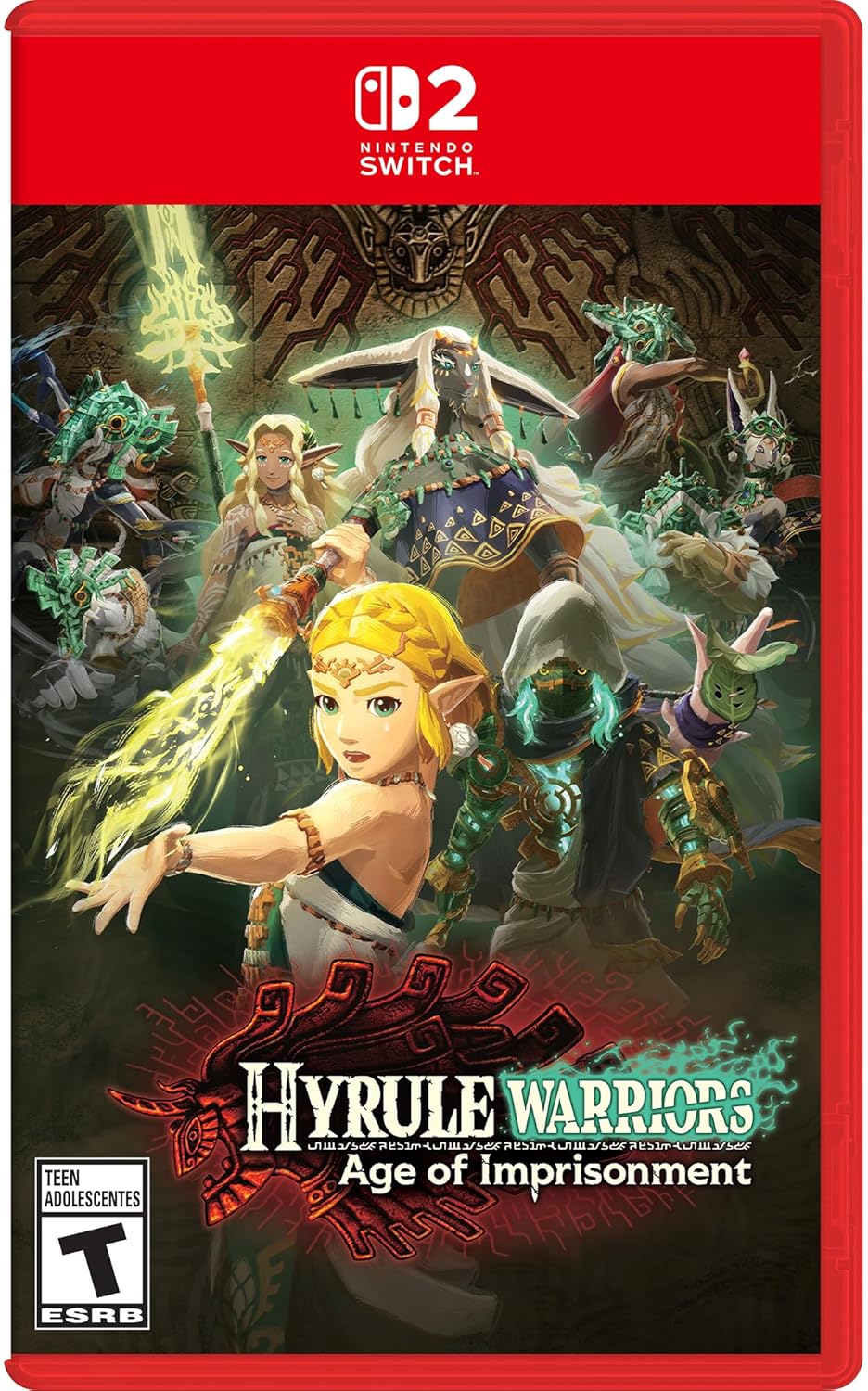
Hyrule Warriors: Age of Imprisonment
Developed By: Koei Tecmo
Published By: Nintendo
Released: November 6, 2025
Available On: Nintendo Switch 2
Genre: Hack-and-Slash
ESRB Rating: T for Fantasy Violence
Number of Players: 1-2 offline
Price: $69.99
(Amazon Affiliate Link)
Thank you Nintendo for sending us this game to review!
It’s hard to believe that the original Hyrule Warriors released eleven years ago! This unusual Legend of Zelda title took characters and settings from across the series’ history and threw them into a mashup game in the style of Koei Tecmo’s Warriors games. Exploration and puzzle-solving were dropped in favor of hack-and-slash combat where you would slay thousands of enemies in various mission-based scenarios. The relationship between Nintendo and Koei Tecmo has only grown, with two Warriors entries under the Fire Emblem series and, more significantly, Hyrule Warriors: Age of Calamity.
Age of Calamity was a Warriors game set 100 years before the events of The Legend of Zelda: Breath of the Wild. It featured many characters and enemies from that game and crafted an enjoyable story that fleshed out Breath of the Wild’s backstory. That is, it had an enjoyable story until around two-thirds of the way through, where the plot drastically broke off from the canon story and left us with a bizarre pseudo-prequel in which Breath of the Wild’s events don’t even occur. In spite of the excellent gameplay, the handling of Age of Calamity’s story was a major disappointment.
Because of this, I was pretty worried when Hyrule Warriors: Age of Imprisonment was announced earlier this year. This entry in this series promises to explore and build upon the backstory of Breath of the Wild’s sequel, The Legend of Zelda: Tears of the Kingdom. Unlike its predecessor, however, Nintendo has repeatedly advertised this game as a canonical prequel to Tears of the Kingdom.
Age of Imprisonment explores the events of Tears of the Kingdom from Zelda’s eyes. (Unfortunately, some spoilers for that game are unavoidable.) After her and Link’s encounter with Ganondorf, who has reanimated after being sealed away for eons, Zelda ends up disappearing, and she wakes up to find that she has been transported back in time to Hyrule’s founding. She is immediately found and taken in by Hyrule’s first king and queen, Rauru and Sonia, and gets accustomed to life in ancient Hyrule while trying to find a way to travel back to the present.
However, those plans are set aside when Ganondorf, who originates from this era, betrays the royal family, becomes the Demon King, and overtakes Hyrule Castle. He then unleashes an army of monsters on Hyrule, intent on wiping out the kingdom. It is up to King Rauru and Zelda to form an army of the people of Hyrule and fight back against the Demon King’s onslaught.
Tears of the Kingdom certainly didn’t put too much of a focus on its story. Some parts of it were very enjoyable, but what we got was admittedly pretty underdeveloped. Age of Imprisonment, however, does a good job of building upon this ancient era of Hyrule. It gave me much more appreciation for the characters mentioned in Tears of the Kingdom. I especially loved how it’s presented in a grander, more cinematic fashion that we wouldn’t normally see in a Zelda game. And yes, Age of Imprisonment is a fully canonical prequel without any of the timeline-splitting shenanigans Age of Calamity suffered from.
Like all Warriors titles, Age of Imprisonment relies on a hack-and-slash style of combat. You repeatedly press Y to perform a basic combo. At any point, you can end the combo with a strong finisher by pressing X. The exact attack you perform will differ based on the exact point you finish the combo, and you’ll quickly memorize the movesets for characters.

Strong Points: Engaging story-driven experience inspired by The Legend of Zelda: Tears of the Kingdom’s backstory; very enjoyable roster of characters
Weak Points: Unfortunate lack of variety in mission objectives
Moral Warnings: Over-the-top fantasy violence in the form of defeating hundreds of enemies at a time, including monsters, ghosts, skeletons, and humans; some suggestive appearances that show midriffs for female characters; plenty of magic use by certain characters; villain referred to as “the Demon King”; references to made-up deities
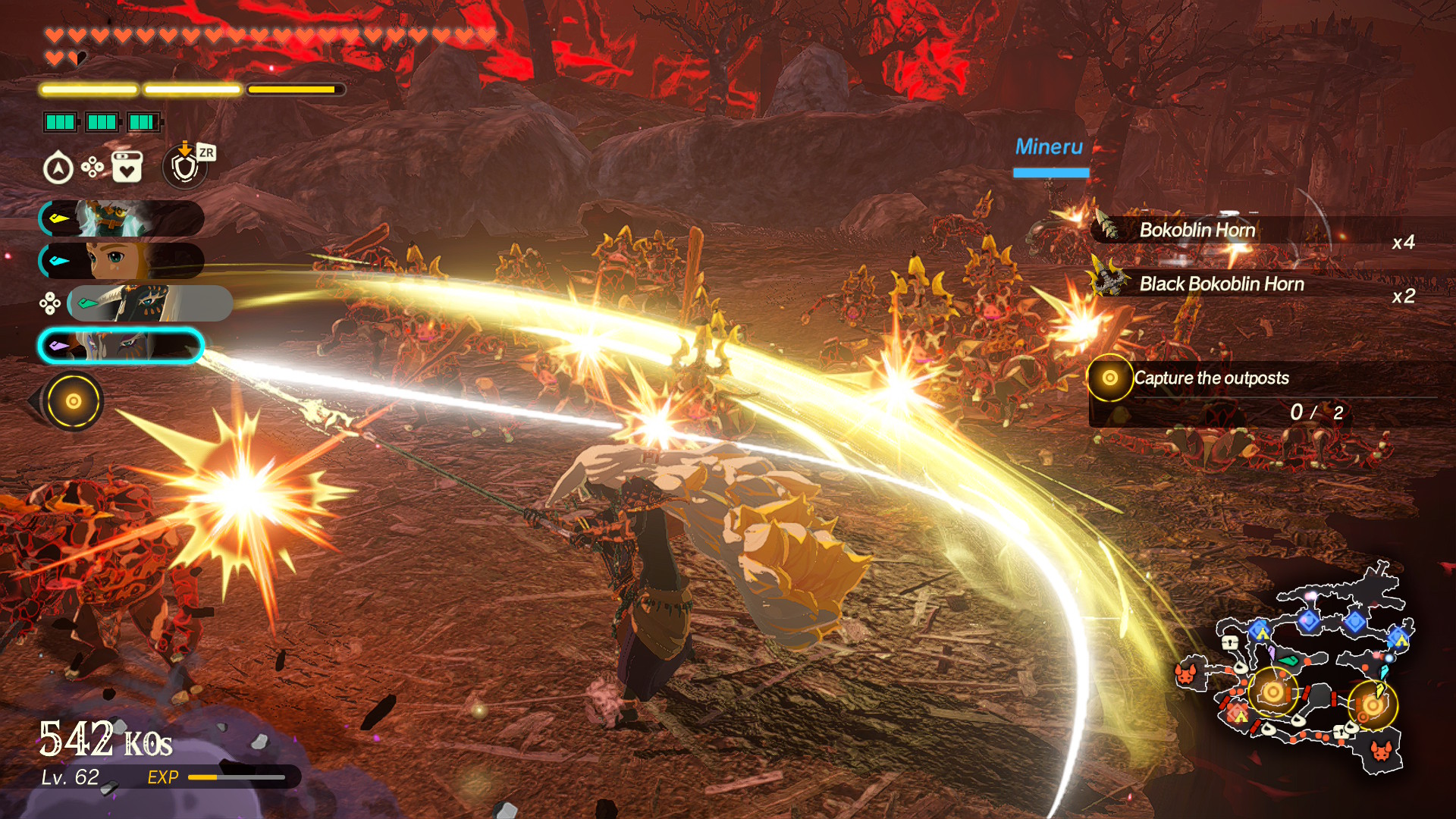
There are always hundreds of smaller enemies on the field that you’ll easily slice and dice, along with stronger enemies that require more focus. Rather than dying from a few swings, these enemies require you to repeatedly strike at them while avoiding their attacks. You’ll find yourself fighting all manner of enemies from Tears of the Kingdom, such as Moblins, Lynels, and robotic Constructs. These enemies also have weak point gauges that appear during openings. If you can shatter this gauge, you’ll be able to perform a powerful finisher that deals a lot of damage.
As you cut through hordes of enemies, your Special Meter will build up. Once it’s full, you can press A to perform a flashy move that can clear out even larger groups of enemies. There is also a new meter called the Sync Strike Gauge. If two characters have it filled, you can press L to watch them perform an extremely powerful attack together. Watching these over-the-top attacks never gets old!
You can also press the right D-pad button to bring up a list of actions you can use. These include attacks known as Unique Skills that go on a cooldown after use and Zonai Devices that consume a battery to inflict elemental damage on enemies. You’ll find that both types of actions will put you at an advantage in certain encounters. For example, a Zonai Flame Emitter will burn through an enemy’s weak point gauge, and certain Unique skills will interrupt an enemy charging toward you. Other actions accessed through this menu include recovery items that restore your health and battery and, for certain characters, materials that can be used in Fuse Attacks, which rapidly consume the selected material to eat away at an enemy’s weak point gauge. You can assign up to five actions to shortcuts, in which you can just tap ZR or hold R and press A, B, X or Y.
Depending on the mission, you’ll be allowed to bring one to four characters into battle. If you played Tears of the Kingdom, it will be no surprise that the roster includes Zelda, King Rauru, his sister Mineru, and the four Sages. There are also some original characters, including a traveling Korok named Calamo. While Link is absent here, you can play as Calamo’s “bud,” a mysterious Construct bearing a striking resemblance to the hero. There are also numerous soldiers you can recruit to your army in side missions. I have to admit that in previous Warriors games, I found myself sticking to certain characters as much as possible while finding much of the roster sluggish and clunky. This time around, while I still gravitated to certain characters, I found almost all of them to be very fun to play.
The two dozen story missions and 100+ shorter challenges are comprised of various objectives that you’ll have to complete in succession, usually until a final enemy appears that you need to defeat. One thing I am not as fond of is the lack of variety in these objectives. Other Warriors games I’ve played had a balanced variety of tasks, requiring you to capture certain outposts or defeat a set number of enemies. You would often have to scramble around the battlefield as you juggle these tasks while simultaneously protecting your own outposts from attacks. Some of that is present here, but it’s not as common. Most of the time, your objectives involve defeating specific targets, and there’s less emphasis on defending outposts or strategizing.
I also have to mention the handful of missions where the mysterious Construct transforms into a flying machine and takes to the skies. These Flight Mode missions play exactly like an on-rails shooter, with you being able to shoot with R, perform barrel rolls with B, and use Zonai Devices you collect as power-ups with ZL and ZR. This style of gameplay feels completely out of left field, but I really enjoyed these missions, even if there aren’t many of them.
Higher is better
(10/10 is perfect)
Game Score - 86%
Gameplay - 17/20
Graphics - 8/10
Sound - -8/10
Stability - 5/5
Controls - 5/5
Morality Score - 85%
Violence – 7/10
Language - 10/10
Sexual Content – 8.5/10
Occult/Supernatural – 7/10
Cultural/Moral/Ethical - 10/10
Like all Warriors games, the entire game can be played with a friend in split-screen co-op. Unfortunately, the framerate takes a huge hit (in my testing, it seemed to run at around 20 FPS), but it’s worth it to at least have the option. In addition, while Age of Imprisonment doesn’t have native online multiplayer, it does support the Switch 2’s Gameshare feature, in which a host system can stream the game either locally or online to a friend, essentially allowing you play online with only one copy of the game.
Age of Imprisonment very successfully recreates Tears of the Kingdom’s cel-shaded art style. The cutscenes especially had a lot of care put into them, blending in perfectly with scenes from Tears of the Kingdom. Now, one of the biggest issues with Age of Calamity was its awful framerate. That game was pretty much stuck at a painful 20 FPS on the original Switch. In single-player, Age of Imprisonment aims for 60 FPS and displays way more enemies at a time. Brief drops are frequent, but it’s a hundred times better than Age of Calamity. The resolution, while lower than other Switch 2 titles, is also much higher than Age of Calamity.
The sound design is unusual, to say the least. Some songs fit in with Tears of the Kingdom’s music, while others sound unlike anything I’ve heard in a Zelda game. There are tracks that rely on choirs, some that seem inspired by tactics games like Fire Emblem, and songs that would be more at home in a dystopian sci-fi game! Not all of the soundtrack is memorable, but there are a handful of truly epic pieces that I’ll likely listen to for quite some time. The voice performances during cutscenes are also very well done, certainly better than previous Zelda games. Although, I am sad that dialogue during battles isn’t also voiced, which I recall the Fire Emblem Warriors games doing.
Even though you’ll find yourself using swords, spears, explosives, and robots to pulverize hundreds of enemies in mere seconds, the over-the-top nature of it makes it feel more cartoony than gruesome. There is no gore, either, besides the fact that you’ll reduce your enemies to a collection of monster parts used for selling or upgrading characters. Most enemies are monsters, with occasional human characters, ghosts, and skeletons mixed in.
A number of female characters have suggestive outfits that expose midriffs. There are also characters who use magical attacks in combat. Ganondorf, of course, uses dark magic and is often referred to as the Demon King. In fact, I would say you'll see more use of magic than in other recent Zelda titles. There are also ghost enemies shown to be able to possess people and machines. However, I was pleased to learn that unlike other Zelda games, there are no references to reincarnation. Also, while there are mentions of made-up deities, those references are few and far between.
As what is most likely the final game set in Zelda’s Breath of the Wild era spanning eight years, I am very happy with Hyrule Warriors: Age of Imprisonment. The story was very enjoyable and provided some much-needed development of the ancient Hyrule from The Legend of Zelda: Tears of the Kingdom. I found the roster to be much more consistently fun than in other Warriors titles. The performance is also much better than in other Warriors games, at least in single-player. There is a lot of violence as you cut down hundreds of monsters, and there are some spiritual elements, but nothing out of the ordinary for Zelda. If, like myself, you wished to see more of Tears of the Kingdom’s ancient Hyrule, and you enjoy hectic hack-and-slash combat, I would definitely recommend Hyrule Warriors: Age of Imprisonment.
-Tyler Ferguson

You May Also Like
Write for us!

Follow Us on X
Watch our next stream!

Allkeys

Save 2% with code CCGR
Follow Us!





-
Verse of the Day - Joshua 1:9
Have not I commanded you? Be strong and courageous. Do not
...
Donate
Please consider supporting our efforts. Since we're a 501 C3 Non-Profit organization, your donations are tax deductible.
Join Our Discord

Who's Online
We have 22500 guests and no members online